
Power In A Box
Is Loadshedding Killing Your Business
or Child's Studies?

Luke - 15 years
I don't know when we are next going to be 'shed - because loadshedding is not relevant to me anymore!
Power In A Box makes loadshedding a thing of the past for your home office, for your children who are studying, for your home essentials like TV and WIFI.
If you run a small office, you know how loadshedding has hamstrung your productivity.
Power in a Box solves loadshedding problems in a cost effective way
Step 1
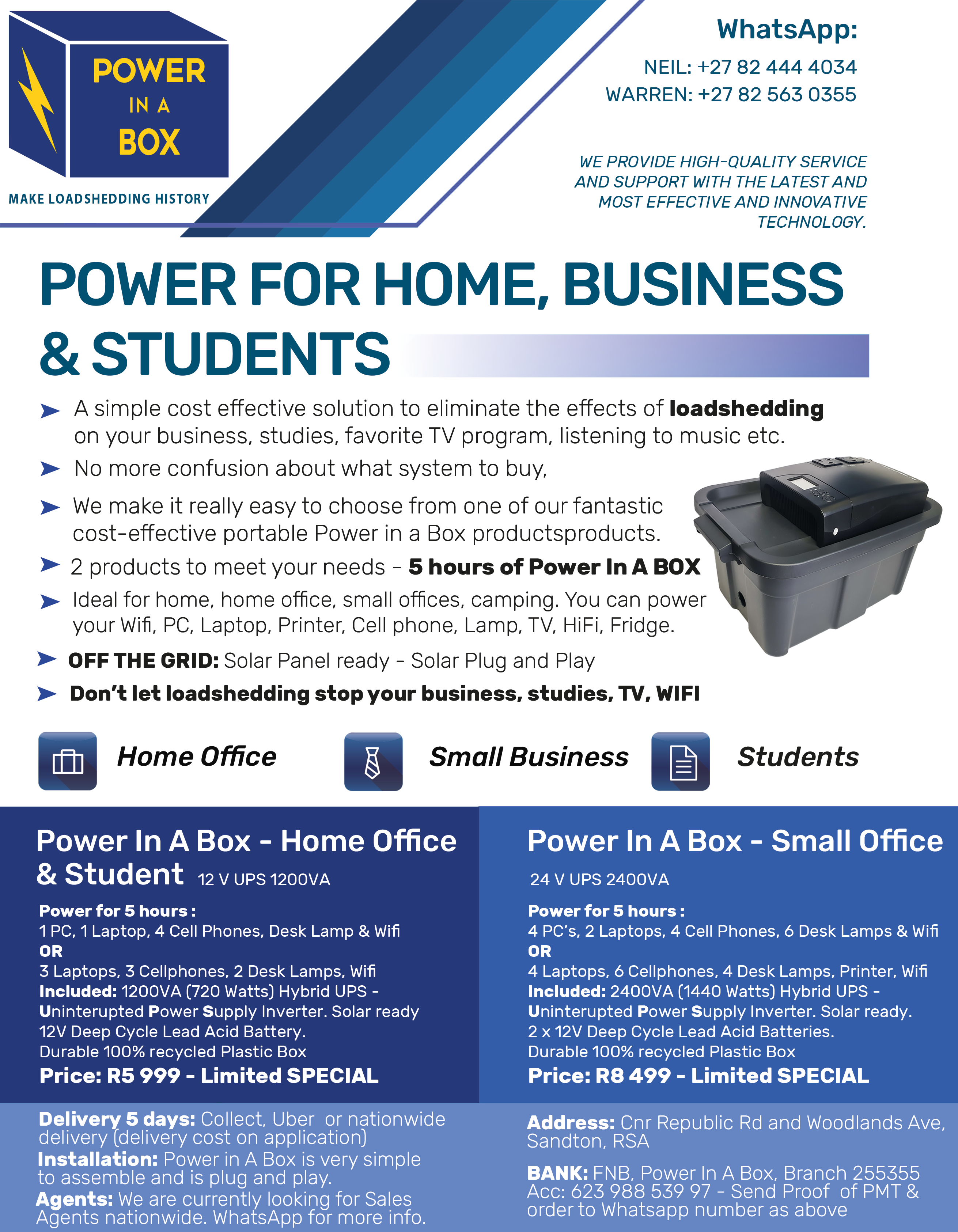
For simple Loadshedding protection, buy a Power in a Box - Small office and Student
Plug your Box into the electricity mains to charge the battery while the power is on, and run off battery power for the duration of the loadshedding blackouts.
Plug your office equipment, laptops and chargers permanently into the Power in a Box unit for uninterrupted power connectivity
WhatsApp Neil on 082 4444 034 to get your Power in a Box - Limited stock at the special of R5999
Step 2
For complete blackout protection, add solar panels to your Box.
Make sure your solar panel or panels are equivalent to double your normal power requirement.
Simply plug the solar panel into your Power In A Box, and run off solar power while you recharge your batteries.
For example, if your standard usage is 150 Watts, get at least 300 Watts of solar panel power.
Power in a Box
Making loadshedding history for your office
Make loadshedding history for students
.... in 2 easy steps!
Step 1 - Unboxing Power in a Box
Step 2 - Unboxing Solar Power your Box
How much power does a small office or home office need to stay up when the power is down?
Typically a home office or small office will require enough power to run 2 PC's, a cellphone charger, desk lamp, and charge an emergency light.
Depending on your PC's this would equate to approximately 100W as demonstrated in this video.
In this short video, we demonstrate how a small office remains unaffected by loadshedding for up to 5 hours.


Get Power in a Box and switch your lights back on
WhatsApp Neil on 082 4444 034 to get your Power in a Box - Limited stock at the special price of R5999
Power in a Box Q&A - Articles
The Enertec Deep Cycle Heavy duty sealed lead acid batteries that we use are designed to last 1600 cycles or 2 to three years daily use
BUT only if handled properly.
If you overload your batteries by “red-lining” them ie discharging it too deeply, or drawing a very heavy load continuously, they will only last a few months, no matter what brand of deep cycle batteries one uses.
Make sure that the inverter or UPS you use has automatic low voltage cutoff set properly to switch off automatically before your batteries discharge too deeply. Deep discharge of you battery will ruin any lead acid battery very quickly. In my experience battery brand is not the main cause of failure, normally unwitting battery abuse is the culprit!!!
Another tip that nobody speaks about is the continuous amperage that your inverter will pull from the battery.
A very experienced battery supply that I have come to rely heavily on recommends that your continuous design load does not draw more than 15 Amps from a 12 V deep cycle battery. This 15 Amp target is guesswork, but experience counts in this industry!
Divide your normal inverter load ( in Watts) by the voltage of your battery ( probably 12 or 24 Volts) to obtain the current draw on your batteries.
EG
A 240 Watt load on a 12 V system would draw 240W/12V = 20 Amps – which is too high !!!
But on a 24 V system, the same load would only be drawing 240W/24 V = 10 Amps which is very low and consequently you can expect excellent endurance from your battery - as long as you do not discharge it to deeply!
Unfortunately load shedding it is effecting every student, every home and small business equally. The lights go off and everything stops, internet, computer, lights, microwave, stove, kettle, electric gate.
Since Covid, schooling and university/colleges have evolved their methods to rely heavily on the internet for, homework, projects and assessments.
I watch my 15 year old son get back from sport at around 6pm with the pressure of another 2 hours of homework to look forward to, only to have to deal with loadshedding from 6pm to 10pm. And every day the loadshedding schedule changes which adds to the stress.
So what is the solution? A generator, inverter, UPS, solar – or completely off the grid?
Heaven help you if you ask a shop assistants advice- I have found that 99% of the population know very little about Volts, Amps, AC current, DC Current, Watts, VA, Ahr. They know even less about batteries and how to select the best battery for your application.
How do you choose ?
Petrol or diesel generator, inverter, UPS or solar
Lets look at the options in more detail and hopefully bring some clarity into this backup power problem that all South Africans have been thrust into.
The pros and cons of each backup power option for a household:
Petrol Generator
Pros:
- Provides high power output for long periods of time, making it suitable for large power needs or prolonged power outages
- Can power larger household appliances and electronics
- Widely available and can be purchased at hardware stores or online
- Can be used for outdoor activities like camping
Cons:
- Requires regular maintenance and fuel refills, which can be costly and time-consuming
- Produces noise and emits exhaust fumes, which can be unpleasant and harmful to the environment
- Can be expensive to purchase initially, as well as operate and maintain over time
- May not be allowed in certain residential areas due to noise
Inverter
Pros:
- Runs quietly and produces no emissions, making it an environmentally-friendly option
- Requires little maintenance and is easy to operate
- Can be powered by renewable energy sources like solar panels
- Portable and lightweight, making it easy to move and transport
- Typically less expensive than petrol generators
Cons:
- Provides limited power output for shorter periods of time, making it less suitable for large power needs or prolonged outages
- Can only power smaller household appliances and electronics
- Requires initial investment in batteries or solar panels, which can be costly
- May require additional equipment or professional installation
- Unplugging from power source and recharging between usage cycles
- May not be suitable for areas with long power outages
UPS
Pros:
- Provides an instant backup power source during short power outages
- Requires minimal maintenance and is easy to use
- Produces no noise or emissions, making it an environmentally-friendly option
- Can be used to protect sensitive electronics from power surges and outages
Cons:
- Provides limited power output for short periods of time, making it less suitable for large power needs or prolonged outages
- Can only power small household appliances and electronics
- May not be suitable for areas with long power outages
In Summary
For a small office or home usage where the load required to run your essential electronics is relatively low, the convenience of a UPS wins every time.
Inverters are bit more inconvenient than a UPS since they generally require you to alternately plug your equipment into the mains or the inverter.
For farms, or areas where noise is not a problem and frequent extended power cuts are common, I would recommend a generator.
And since we live in sunny South Africa, I believe the target for every household should be to move to solar (normally in stages) in a totally off the grid solution.
Loadshedding is playing havoc with all of us. For those working in large offices, you probably have power backup all sorted! But what about the small businessman or woman.
With a small office, cashflow is everything, and for the cash to flow, you need to remain productive.
Small businesses normally operate from home or rented premises making a permanent solar backup system impossible.
Power In A Box was developed for precisely this reason.
How to get off the grid.
Step 1 – Make loadshedding history – buy a Power In a Box unit.
The basic Power In A box unit plugs into mains power and charges the batteries while the power is on. Then when the lights dip, you don’t.
In this video, I unbox our entry level unit (Power in a Box – Small office and Home) so that you can see all the components and how simple it is to install.
To avoid your battery running dry before the power comes back on, and to ensure that the battery lives up to its design life, it is vitally important that you select the correct model.
- Total up the power requirements of all your absolutely essential equipment such as PC, Laptops, celllpone charger, desk lamp. If you don’t have a power meter ( Who has ?
 ), check the each item to see its power input requirements – normally stamped underneath each item.
 - In our example used in this short video, we totaled 96W for 1 desktop PC, 1 screen, 1 PC, 1 lamp, cellphone charger, WIFI and an emergency lamp.
- The entry level Power In A Box comes with a 12 Volt, 80Ahr heavy duty, deep discharge, sealed lead acid battery. In your capacity calculations, always plan on using only 50% of the total capacity to ensure that your battery does not expire early. I liken using all of your capacity to over revving your car between every gear. That car wont last very long. Experience has taught us to use only 50% capacity.
- To work our how many hours your small office will safely run while Eskom has put you in the dark, you will need to remember some school electricity… or just follow these steps.
Usage = 96W, battery 12V 80Ahr
Amps draw on your battery = 96W/12V = 8 Amps.
Half capacity of the battery is 40 Ahr.
40 Ahr/8 A = 5 hours
This means that with a constant load of 100W, you can safely run for 5 hours.
In this short video, Eskom obliged me by providing a blackout as precisely the correct time to demonstrate the uninterrupted power the Power in a box supplied
Step 2 Beat the blackouts – get your office off the grid.
Our aging electrical infrastructure was not designed to switched on and off 8 times a day. As a result we frequently experience localized blackouts for 2 or three days at the time and sometimes even longer. The answer is to connect your Power In a Box unit to solar power.
This is far easier than you might think. The Power In A Box unit comes solar ready, simply plug an play as shown in the video below.
Using the above example of 96 Watts to run your office essentials, we recommend a solar panel of between 100 and 350 W. The bigger your panel, the quicker your battery will charge up. But since you are only using 96 Watts, a very good bang for your Buck is a 200W solar panel .
Unboxing the Solar panel.
In the video, it is clear that on a normal sunny day, your small office can run completely off the grid. During sunny hours the solar panel will supply all your power requirements with more than enough left over to charge up your batteries. When the sun sets your battery takes over, giving you an additional 5 hours.
This 5 hours is easily extended to 10 hours by installing another battery in parallel to the first one, giving you 80 usable Amp hours.
On a cloudy day, you will have the option of connecting to the grid and relying on Eskom to charge your batteries between Loadshedding events.
Load shedding is having a significant and adverse impact on South Africans in many ways.
- Load shedding disrupts daily life, causing inconvenience and frustration. Scheduled power outages mean that work is disrupted, you are unable to cook meals, use appliances, do your homework, access the internet.
- Small businesses: Load shedding has a significant impact on businesses, with power outages causing disruption to everyday work activities. When the power dips, so does your productivity and you lose income.
- Security: Load shedding can result in increased crime as security systems, alarms and streetlights are disrupted.
- Health concerns: Load shedding can affect life-saving medical equipment like respirators for the sick frail and aged.
- Loss of perishable goods: How much food have you lost due to loadshedding ?
- Emotional stress: Load shedding causes emotional stress, with people feeling anxious and uncertain about when power will be restored, how to meet deadline, how to finish your homework causing a sense of powerlessness and helplessness.
- It is essential to address the Loadshedding problem as it is here for the foreseeable future, I am afraid.
The Solution
So what are the options for a household or a small business ? What if you work from home, since so many South Africans are working from home or running a small business from home.
The obvious solution is to install a substantial solar power system and get off the grid completely, get control back and stop being subject to the dreadful inefficiencies and inconvenience of Loadshedding. But unfortunately for most South Africans, this costs a small fortune upwards of R400 000.
A phased approach
Step 1
Load-shed proof your home office, your students, your entertainment like TV and internet.
Get a Power In A Box – Home and Student UPS. Its a great cost effective solution, which stays plugged into the grid while supplying you power that is uninterrupted when loadshedding kicks in.
This short video demonstrates the capabilities of Power In A Box, and as providence would have it, I was loadshed while filming which provided a great live demonstration of the system.
Step 2
Purchase a single solar panel sized between 200 and 350 Watts and plug it directly into your Power in A Box. 5 or 6 hours in full sun is enough to keep your battery charged and supply you with electricity all day. This will take your basic homeoffice/entertainment/student essentials completely off the Grid.
To order your Power in a Box, simply whatsapp Neil 0824444034 or Warren 082 563 0355 - provide your delivery/collection details and we will send you a proforma invoice for payment to confirm your order.
Your delivery options are:
Collections: In person or by Uber from our Sandton office. Corner Republic and Woodlands Ave, Hurlingham, Sandton
Courier: Please email your delivery details to obtain a quote you on delivery cost.

Power in a Box – A short analysis by Armand du Plessis
Battery: Brand | ENERTEC M24-BLC 80Ah DEEP CYCLE BATTERY |
Current Capacity | 80Ah |
Voltage | 12V |
Type | Sealed Lead Acid Calcium / Calcium Deep - Cycle |
UPS: Brand | CRYSTAL HYBRID |
Rated input | 1200 VA |
Rated output | 720 W |
Type | Inverter Battery Charger Combinaon |
Solar input | 50 A PWM controller |
Sine Wave | Modified (Can’t add anything with a motor – only lights, TV, laptops) |
Notes:
The advert mentions 5 hours of energy.
The battery has 80 Ah x 12 V = 960 Wh. However, an average "depth of discharge" of around 50% is suggested as the best for storage vs cost.
Thus, you have 960/2 = 480 Wh.
If you have 2 hours of loadshedding, that means you can run 240W of power consumption for 2 hours. (2h x 240W = 480Wh).
In general – you can run the following: |
Item | Power |
Wifi router | 30 W |
Fibre internet box | 10 W |
TV | 150 W |
DSTV | 25 W |
3x Lights/Lamps (11Wat = 60Wat brightness) | 33 W |
TOTAL | 238 W |
| |
|
Alternatively
Item | Power |
Wifi router | 30 W |
Fibre internet box | 10 W |
PC | 150 W |
PC Screen – 24 inch | 25 W |
2x Lights/Lamps (11Wat = 60Wat brightness) | 22 W |
TOTAL | 237 W |
In general it seems like a fair deal for what you are getting.
An equivalent product is the EcoFLow RIVER. But it only has 288 Wh in total (which is effectively half if you discharge 100%) – which sells for R7500. Given that even at 50% discharge, the Power in a Box is sill 480 Wh, this Power in a Box is a great product in comparison. Just note, the EcoFLow product can charge to 80% in 1 hour. It is not clear how long it will take the Power in a Box to charge before it reaches full capacity again.
Also note: If you discharge the battery beyond 50%, then you will drastically reduce the lifeme of the battery. You can ensure this by not exceeding the 240 W power consumption. In other words, don’t run a total power demand of 240 W for more than 2 hours. (or don’t run more than 120 W for 4 hours)
My recommendation is to do a similar energy audit as in the example table in this document, where you tabulate all of the items you want to run. Then just add up the total power consumption and make sure it is more or less 240 W. Also, just note, because it is a modified sine wave inverter and not a pure-sine-wave inverter, the fridge might not run as efficiently. Anything that uses an AC motor isn't going to work to full capacity on a modified sine wave. Appliances like refrigerators, microwaves, and compressors that use AC motors won't run as efficiently on a modified sine wave as they would on a pure sine wave.
If you want to run devices for 4 hours, then you must not exceed 240 W / 2 = 120 W. Otherwise you must double the battery capacity, by adding another battery in parallel.
To do the calculations yourself:
Step 1: Determine battery capacity
Step 2: Divide the capacity in 2, to ensure a maximum of 50% discharge
Step 3: Divide the True Capacity by the number of hours you want to run the system (i.e 2 hours for typical loadshedding, or 4 hours for long load shedding). This will be the total power consumption that you can supply. (in our example above this was 240 W)
Overall, the “Power in a box” seems like a good product for the general house-hold consumer.
However, it should be considered how long it takes the “power in a box” to charge the sealed lead-acid battery to a 100% capacity. It is suspected, given a depth of discharge of 50%, that it will take 8 hours. So if there are multiple sessions of loadshedding, with less than 8 hours in between, it might result in discharging the battery more than 50% for some of the sessions. Typically, load shedding is 6 hours in between (stage 4), so it is recommended to reduce the power consumption to about 80% of the “total allowed power consumption” value calculated in step 3 above. Therefore, in our example above, it will reduce the load from 240W to 200 W. Then it will be a system with lifeme optimized for Stage 4 loadshedding, which means more value for your money.
This short analysis has been completed by:
Armand du Plessis
